


How to Start Your Own Spirit Brand in 2026: The Craft Distiller’s Guide
So, you’ve got a dream. It’s a vision of a beautifully designed bottle, filled with a spirit that tells a story, sitting proudly on a back bar or a friend’s shelf. The idea of starting your own spirit brand is intoxicating, but the path to get there can feel shrouded in mystery, red tape, and technical jargon. Where do you even begin?
You’re in the right place. Forget the overwhelming business plans and corporate checklists for a moment. Launching a successful craft spirit brand in 2026 is less about building a factory and more about bottling a philosophy. It’s an art form that marries timeless tradition with a bold, modern narrative. It’s about creating something with soul.
Here at Kilted Dragon Distillery, we’ve not only walked this path ourselves but we’ve also become trusted partners for countless other dreamers looking to bring their vision to life. This guide is our way of pulling back the curtain, sharing what we’ve learned, and giving you a clear, step-by-step roadmap. We’ll take you from that first spark of an idea to the satisfying clink of your first bottled batch.
Let’s get started.
Table of Contents
Finding Your Identity: The Core Philosophy of Your Spirit Brand
The Legal Foundation: Navigating UK Licences and Regulations
Crafting the Liquid: Recipe Development and the Distillation Process
Dressing the Bottle: Branding, Packaging, and Visual Storytelling
Launching into the Market: Distribution and Finding Your Production Partner
Finding Your Identity: The Core Philosophy of Your Spirit Brand
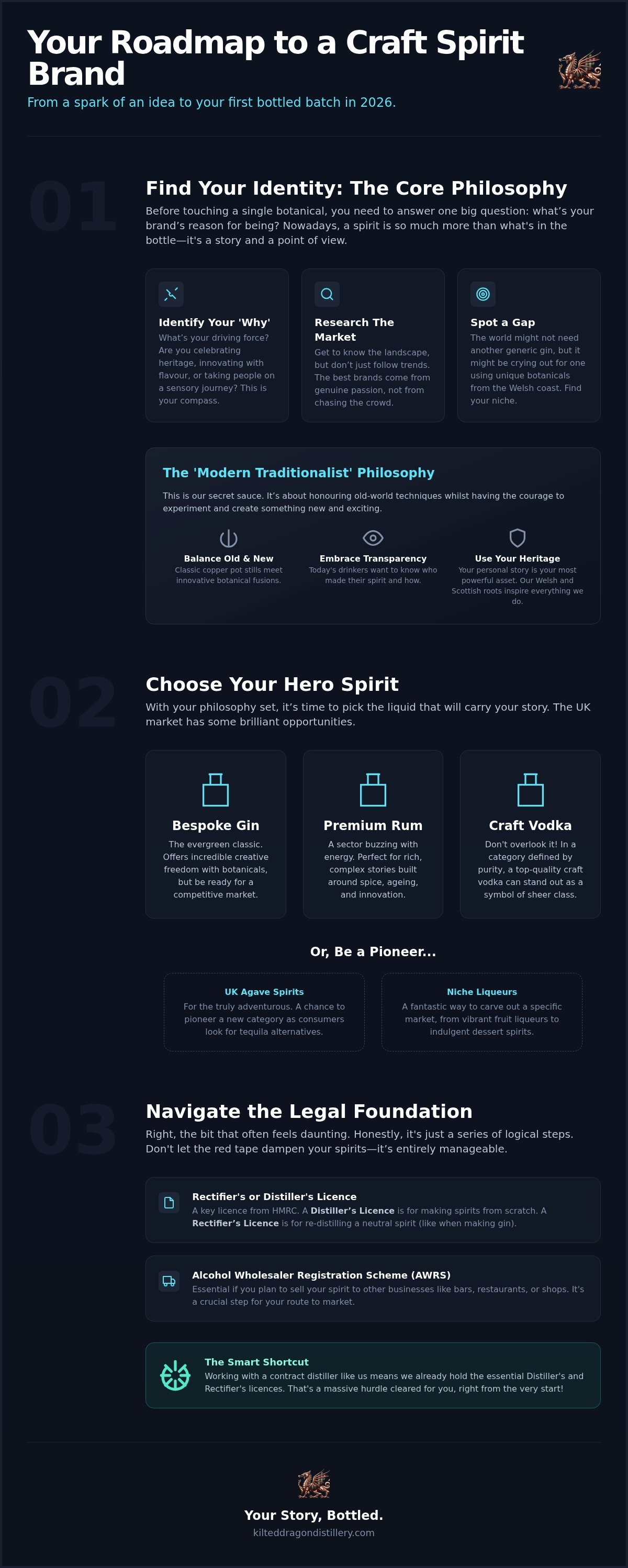
Before you think about botanicals, bottles, or business licences, you need to answer one fundamental question: what is your brand’s reason for being? In the modern craft era, a spirit brand is so much more than the liquid inside the bottle; it’s a story, an experience, and a point of view. This is your foundation.
Define what a spirit brand is today: It’s a story in a bottle. Consumers aren’t just buying gin or rum; they’re buying into your narrative, your passion, and your unique perspective.
Identify your “Why”: What’s the driving force behind your idea? Are you looking to celebrate your family’s heritage, push the boundaries of flavour with bold innovation, or take people on a specific sensory journey? Your “why” will be your compass.
Research the market whilst staying true to yourself: It’s vital to understand the landscape, but don’t let trends dictate your vision. The most successful brands are born from genuine passion, not from chasing the crowd.
Spot a gap in the UK market: The world might not need another generic London Dry Gin, but it might be crying out for one that uses unique, locally foraged botanicals from the Welsh coast. Look for the gaps that your unique story can fill.
The Modern Traditionalist Approach
The sweet spot for craft spirits in 2026 lies in a concept we call the “Modern Traditionalist.” It’s about respecting the time-honoured techniques of distillation whilst having the courage to experiment and innovate. It’s a philosophy that guides everything we do.
Balance old-world techniques with contemporary ideas: Think classic copper pot distillation meets innovative botanical fusions. This blend of old and new creates spirits with both depth and excitement.
Embrace transparency and artisanal roots: Today’s consumer is savvy. They want to know where their spirit comes from, who made it, and how it was made. Being open about your process and ingredients builds trust and loyalty.
Use your personal heritage to create an authentic narrative: Your own story is your most powerful asset. Our Welsh and Scottish roots, for example, are woven into the DNA of Kilted Dragon, inspiring everything from our name to our flavour profiles.
Choosing Your Hero Spirit
With your core philosophy in place, it’s time to choose the liquid that will carry your story. The UK market is diverse, offering incredible opportunities across several categories. Each has its own personality, production process, and market position.
Gin vs. Rum vs. Vodka: The big three each offer a unique starting point. The evergreen appeal of a bespoke gin lies in its versatility and creative freedom with botanicals, but the market is competitive. Premium rum is a sector buzzing with energy and innovation, perfect for rich, complex stories built around spice and ageing. And don't overlook the potential of a super-premium craft vodka; in a category defined by purity, a meticulously distilled spirit made with quality ingredients can stand out as a symbol of sheer quality.
The rise of UK agave spirits: For the truly adventurous founder, homegrown agave spirits offer a chance to be a pioneer. As consumers seek alternatives to tequila, a well-crafted UK agave spirit brand can capture a premium, forward-thinking audience.
The unique niche of liqueurs: Liqueurs present a fantastic opportunity to carve out a specific niche, from vibrant fruit liqueurs to indulgent dessert spirits. They can be a great entry point or a way to expand your brand portfolio later on.
The Legal Foundation: Navigating UK Licences and Regulations
Here’s the part that often feels the most daunting, but we promise it’s perfectly manageable. Navigating the legal requirements of selling alcohol in the UK isn’t about battling bureaucracy; it’s simply a series of logical steps designed to ensure everything is done safely and correctly. Don’t let the red tape dampen your spirits.
It’s just a series of logical steps: Approach it methodically, and you’ll find it’s not the mountain it first appears to be. Working with a partner like us can simplify this process immensely.
The Rectifier’s or Distiller’s Licence: This is a key licence from HMRC. A Distiller’s Licence allows you to produce spirit from scratch (e.g., fermenting molasses for rum). A Rectifier’s Licence allows you to take a neutral spirit and re-distil or compound it (e.g., making gin). If you work with a contract distiller, they hold these licences, saving you a huge hurdle.
The Alcohol Wholesaler Registration Scheme (AWRS): If you plan to sell your spirit to other businesses (like bars, restaurants, or shops), you’ll need to be registered with the AWRS. It’s a crucial step for your route to market.
Duty Representation: When spirits are produced, they are typically held "in bond" without the tax (excise duty) being paid. If you aren’t storing the spirit yourself in a bonded warehouse, you’ll need a Duty Representative who handles the tax payments on your behalf when the stock is released.
HMRC and the Tax Man
Understanding the financial obligations from day one is essential for pricing your product correctly and running a sustainable business. It might sound complex, but it’s all about good record-keeping.
A breakdown of excise duty: This is the tax levied on alcohol, calculated based on the volume and alcoholic strength (ABV). It’s a significant portion of your bottle’s cost, and you must factor it into your pricing strategy. We’ll be sure to verify the 2026 HMRC duty rates as we approach the year.
The basics of VAT: Like most products in the UK, your spirit will be subject to Value Added Tax (VAT). Keeping meticulous records of your sales and purchases is non-negotiable.
Why working with an established distillery simplifies your tax life: When you partner with a contract distiller, we handle the complexities of holding spirits in bond and managing the duty process. This frees you up to focus on building your brand.
Labelling and Health Standards
Your label is a key piece of marketing, but it’s also a legal document. Getting it right is crucial for compliance and for building consumer trust.
UK labelling requirements: There are several things that MUST be on your bottle. This includes the ABV (Alcohol By Volume), the net volume of the liquid (e.g., 70cl), the number of units of alcohol, and an address for your brand.
Navigating health warnings and allergen claims: You must include the correct pregnancy warnings and be truthful about any allergen information. Accuracy is paramount.
How to ensure your claims are legally sound: Words like "hand-crafted," "small-batch," or "local" have meaning. You need to be able to stand by these claims. For example, "Welsh Gin" should be distilled in Wales. Authenticity isn’t just good marketing; it’s a legal requirement.
Crafting the Liquid: Recipe Development and the Distillation Process
This is where your brand’s story transforms from an idea into a tangible, sensory experience. Developing a unique recipe is a journey of creativity, precision, and collaboration. It’s a meticulous process, but it’s also where the real magic happens.
Step 1: Ideation—This starts with a conversation. We translate your flavour concept, your story, and your inspiration into a potential list of ingredients, whether it’s botanicals for a gin, a spice blend for a rum, or a unique base for a vodka.
Step 2: Trial Distillation—We then move to our small-batch test stills. This is the playground of experimentation, where we run multiple tiny distillations, tweaking the recipe each time until we’ve captured the exact flavour profile you’re looking for.
Step 3: Scaling—Once we’ve perfected the recipe on a small scale, we meticulously calculate how to scale it up for a full production run in our larger stills, ensuring the flavour remains perfectly consistent.
Step 4: Quality Control—Every single batch that leaves our distillery is tasted and tested to ensure it’s as perfect as the first. Consistency and quality are the pillars of a great reputation.
The Magic of the Copper Pot Still
The equipment used to make a spirit has a profound impact on its final character. We are firm believers in the power of traditional copper pot stills to create a spirit with unparalleled smoothness and depth of flavour.
Why traditional copper stills produce a superior spirit: Copper is not just for show. It acts as a catalyst during distillation, reacting with volatile sulphur compounds and removing them from the spirit. This natural purification process results in a cleaner, smoother finish.
The role of “heads, hearts, and tails”: During a distillation run, the spirit comes off the still in three parts. The "heads" (first part) contain volatile alcohols and are discarded. The "tails" (last part) contain heavy, oily compounds and are also set aside. The distiller’s art is in making the perfect "cut" to capture the "heart" of the run—the purest, most flavourful part of the spirit.
Impact on purity: For spirits like vodka and gin, where purity and a clean palate are essential, this meticulous process in a copper pot still is what separates a good spirit from an exceptional one.
Innovative Flavour Pairings
Your recipe is your signature. It’s your chance to create something truly memorable that stands out in a crowded market.
Mixing traditions: Don’t be afraid to blend influences. Our Scwelsh gin, for example, is a celebration of our heritage, creating a beautiful fusion of Welsh and Scottish botanicals.
Sourcing sustainable, high-quality ingredients: The quality of your raw materials directly translates to the quality of your final spirit. Sourcing the best, most sustainable ingredients not only creates a better product but also becomes a powerful part of your brand’s story.
Experimenting with bold profiles: Think beyond the obvious. Exploring unique ingredients like smoked agave for a UK-based spirit or developing a complex spiced rum can give your brand a bold, unforgettable edge.
The Art of Blending
The process doesn’t end when the still is switched off. The final steps of blending and finishing are just as crucial for creating a consistent, high-quality product.
Why blending is key for consistency: For larger batches, blending the hearts from several distillation runs ensures that every single bottle you produce tastes exactly the same.
Using water quality to define character: The water used to dilute the spirit from still-strength down to bottling-strength plays a huge role in the final taste and mouthfeel. We use pure, filtered Welsh water to give our spirits their signature smooth character.
The final touch: "marrying": After dilution, the spirit is often left to rest for a period. This process, known as "marrying," allows the alcohol and water molecules to fully integrate, resulting in a rounder, more cohesive final product.
Dressing the Bottle: Branding, Packaging, and Visual Storytelling
Long before anyone tastes your spirit, they will see it. Your bottle and label are your silent sales team, working tirelessly on the shelf to capture attention and communicate your brand’s essence. It needs to look and feel as good as the liquid tastes.
Your bottle is your silent salesman: In a sea of options, your packaging has a split second to make an impression. It needs to scream quality, intrigue, and professionalism.
Choosing a bottle shape that reflects your brand’s personality: Is your brand modern and minimalist, or is it rustic and traditional? The shape of your glass should be the first clue.
The tactile experience: Don’t underestimate the power of touch. A thick, textured paper for the label, an embossed logo, a weighty cork, or a beautifully crafted foil seal all signal a premium product.
Using colour and typography: These are powerful tools for communicating your flavour profile. Rich, dark colours might suggest a spiced rum, while bright, clean typography could signal a crisp, refreshing gin.
Building a Sensory Brand
Great branding goes beyond a logo. It’s about creating a world that your customers can step into, using language and visuals to evoke the feeling of your spirit.
Transport the reader through evocative copy: Use sensory language on your website and label. Instead of saying "tastes like citrus," try "a bright burst of zesty pomelo peel." Paint a picture with your words.
The importance of “origin stories”: Every craft spirit has a story of how it came to be. Sharing this journey—the inspiration, the trials, the triumphs—creates a powerful emotional connection with your audience.
Extend the brand experience with merchandise: Well-designed merchandise like glassware, apparel, or cocktail kits allows your biggest fans to literally wear their support and become ambassadors for your brand.
Sustainable Packaging Trends
In 2026, sustainability isn’t a bonus; it’s a baseline expectation for any premium brand. Building eco-friendly practices into your packaging from day one is not only good for the planet but also a compelling marketing message.
Eco-friendly glass and recycled labels are non-negotiable: Consumers are actively looking for brands that share their values. Opt for lightweight glass bottles made from a high percentage of recycled material and choose labels made from recycled paper.
Reduce plastic in your shipping: Explore plastic-free packaging solutions for your e-commerce shipments. Options like cardboard protectors and paper-based tape make a big difference.
Make sustainability a core part of your narrative: Talk about your choices. If you source botanicals from a sustainable farm or use 100% recyclable packaging, share that story. It demonstrates integrity and a commitment to quality in every aspect of your business.
Launching into the Market: Distribution and Finding Your Production Partner
You’ve got your philosophy, your recipe, and your branding. Now, how do you actually get your spirit made and into the hands of customers? This is where you face a major decision: do you build your own distillery or partner with an expert?
Self-distilling vs. contract manufacturing: Building and licensing your own distillery is a multi-year, capital-intensive undertaking. For most new brands, starting with a contract partner is the smarter, faster, and less risky path.
The benefits of a contract partner: Working with a contract distiller gives you immediate access to state-of-the-art equipment, years of expertise, and all the necessary licences. It dramatically lowers your start-up costs and allows you to focus on marketing and sales.
Developing a route to market: How will you sell? Starting with direct-to-consumer online sales gives you the best profit margin and a direct relationship with your customers. You can then expand into independent bars, farm shops, and specialist retailers.
The power of brand-building experiences: Inviting people into your world is incredibly powerful. Even if you contract distill, you can host tastings or partner with your distillery for distillery experience days to build a loyal community.
Choosing the Right Contract Distiller
This is one of the most important relationships you will form. Your contract distiller isn’t just a supplier; they are the custodian of your liquid and a key partner in your success. Look for more than just a factory.
Find a partner who shares your passion: You need someone who is as obsessed with quality and craft as you are. They should be excited by your vision and dedicated to helping you achieve it.
Evaluate their technical capabilities: Can they handle the specific spirit you want to create? If you have plans to expand your range in the future, check if they have the expertise to produce liqueurs or other spirits as well as your initial launch product.
The importance of “low minimum order quantities” (MOQs): For a new brand, starting with a smaller initial production run is crucial for managing cash flow. A distillery that offers flexible, low MOQs is a sign that they understand and support start-ups.
Marketing Your Masterpiece
With your spirit produced and ready, it’s time to tell the world. Your marketing should be as authentic and well-crafted as your liquid.
Leverage social media for storytelling: Use platforms like Instagram to share beautiful imagery, behind-the-scenes content of the distillation process, and the story of your brand’s creation. It’s a direct line to your community.
The role of tastings and events: The best way to sell a spirit is to get it into people’s glasses. Attend local markets, host tasting events, and partner with bars to let people experience your product firsthand.
Be a “Modern Traditionalist” in your digital presence: Your website and social media should reflect your brand’s philosophy. Marry beautiful, evocative storytelling with a simple, seamless e-commerce experience. Make it easy for people to fall in love with your story and even easier for them to buy a bottle.
Frequently Asked Questions
Do I need to own a distillery to start my own spirit brand?
Absolutely not! This is one of the biggest misconceptions. Using a contract distiller, also known as a third-party distiller, allows you to produce your spirit using their equipment and licences. It’s the most common, cost-effective, and efficient way for new brands to get started, removing the enormous upfront cost and complexity of building your own facility.
How much does it cost to launch a craft spirit brand in the UK?
This varies wildly depending on your choices, but working with a contract distiller significantly reduces the cost. Your main expenses will be recipe development, the liquid itself (based on volume), dry goods (bottles, corks, labels), branding and website design, and initial marketing. You can get started for thousands of pounds, rather than the hundreds of thousands or even millions required to build a distillery.
What licences do I need to sell alcohol online in the UK?
To sell alcohol directly to the public, you need a Personal Licence and a Premises Licence from your local council. The Premises Licence applies to the location where the alcohol is stored and dispatched from. If you’re using a fulfillment centre or your contract distiller to ship orders, they will hold the necessary Premises Licence.
How long does it take to develop a custom spirit recipe?
The creative process can take anywhere from a few weeks to a couple of months. It depends on the complexity of the spirit and how clear your initial vision is. The journey involves initial consultations, small-scale trial distillations, and tasting feedback sessions until the recipe is absolutely perfect.
What is the minimum volume for contract distilling in the UK?
This differs between distilleries. Many larger facilities have very high minimum order quantities (MOQs), which can be a barrier for start-ups. At Kilted Dragon, we pride ourselves on being accessible to new brands and offer flexible, low MOQs to help you get started without a huge financial commitment.
Can a contract distiller help with my bottle and label design?
Some can, and it’s a huge advantage if they do. A distiller who understands the whole process can provide invaluable guidance on sourcing the right bottles, corks, and capsules. Here, we offer complete branding and production support, ensuring your packaging is not only beautiful but also practical for bottling lines and compliant with all legal requirements.
Is it better to start with a gin, a rum, or a vodka brand?
There's no single "better" option; the best choice depends entirely on your brand story, target audience, and market goals. Gin offers huge creative freedom and is popular, but the market is very crowded. Rum is a rapidly growing premium category with great storytelling potential, especially with spiced or aged expressions. Vodka is a massive market where a focus on purity, quality ingredients, and exceptional branding can create a highly successful premium product. The best spirit is the one that you are most passionate about and that best fits the unique story you want to tell.
What is a Rectifier’s Licence and do I need one?
A Rectifier's Licence, issued by HMRC, allows a business to take a pre-made neutral spirit and alter it—for example, by re-distilling it with botanicals to make gin or by compounding it with flavourings to make liqueurs. You do not need one personally if you are working with a contract distiller, as they will hold the necessary licence to produce your spirit legally.

Comments