


Pure Small Batch Vodka: Why Craft Distilling Changes Everything in 2026
Ever bought a bottle of vodka labelled “triple-distilled” or “ultra-pure,” only to be met with a harsh, medicinal burn that sends you reaching for the nearest mixer? You’re not alone. The world of vodka is filled with marketing terms that sound impressive but often mean very little. They promise a clean, smooth experience but deliver a sharp, forgettable spirit that does little more than add alcohol to your cocktail.
But what if we told you that true purity in vodka isn’t about stripping away every last trace of character? What if it’s about something more nuanced, more artful? At its heart, a truly pure small batch vodka is the result of a distiller’s skill, patience, and an almost obsessive focus on quality over quantity. It’s a spirit crafted with such precision that it’s not just smooth enough to sip neat—it’s a genuine pleasure to do so.
In this guide, we’re pulling back the curtain on the craft of distilling. We’ll explore what “purity” really means, why the small-batch approach changes everything, and how you can spot a genuinely exceptional vodka. It’s time to leave the burn behind and discover a world of flavour and texture you never knew vodka could have.
Table of Contents
What does 'pure' actually mean for a small batch vodka?
When we talk about purity in spirits, it’s easy to think of it in clinical terms—something sterile and completely neutral. But in the world of craft distilling, that’s only half the story. True purity isn’t just about what’s been removed; it’s also about what has been skilfully preserved.
Defining purity in spirits: For us, purity is about the absence of unwanted impurities—the harsh, volatile compounds that cause that notorious “burn” and leave you with a fuzzy head the next morning. It’s not about creating a spirit that tastes of nothing; it’s about creating one that tastes clean, crisp, and beautifully crafted.
The misconception of multiple distillations: You’ve seen it on countless bottles: “Five Times Distilled!” While it sounds impressive, more distillations don’t automatically equal more purity or better quality. In fact, over-distilling can strip a spirit of all its character, leaving you with little more than ethanol and water.
The source of the base ingredient: The final texture and subtle character of a vodka are born from its source. Whether it’s wheat, rye, barley, or potatoes, the base ingredient imparts a unique mouthfeel. A great distiller doesn’t try to erase this; they work with it to create a spirit with a soft, creamy, or even peppery profile.
The vital role of water: Vodka is up to 60% water, so its quality is non-negotiable. The mineral content of the water used to blend the spirit down to bottling strength has a massive impact on the final taste and texture. Small-batch producers often go to great lengths to source pure, soft water that complements their spirit.
Beyond the label: Marketing vs. Reality
The language used to sell mass-market vodka can be misleading. Labels are designed to suggest quality, but the reality of industrial production is often very different. A craft distiller’s priorities, however, are focused squarely on what’s inside the bottle.
Why "triple-distilled" is often the bare minimum: In large-scale industrial production using massive column stills, distilling a spirit three times is standard practice just to make it legally compliant and palatable. It's not a marker of luxury; it's often just the starting point.
Quality over high-volume repetition: Small batch producers aren’t trying to make millions of identical bottles. They are focused on perfecting every single run. This allows them to make tiny adjustments to temperature, timing, and cuts, ensuring each batch is the best it can be.
"Chemically pure" vs. "pleasantly pure": A spirit can be chemically pure (just ethanol and water) yet taste harsh and unpleasant. A “pleasantly pure” spirit, on the other hand, has had the undesirable compounds removed whilst retaining the subtle, pleasing characteristics from its base ingredients. That’s the craft difference.
The chemistry of a clean spirit
To understand purity, it helps to know a little about the science behind that dreaded burn and the morning-after regret. It all comes down to tiny compounds that separate the good from the bad.
A brief look at congeners: Congeners are chemical compounds produced during fermentation and distillation. Whilst some can add desirable flavours (especially in whisky or rum), others, like methanol and certain esters, contribute to harshness and hangovers. A key goal in vodka production is to remove these unwelcome guests.
Reducing the "medicinal" smell: That sharp, almost antiseptic smell common in cheaper vodkas is often due to a higher concentration of volatile compounds from the start of the distillation run. Artisanal methods are far more precise, ensuring these elements never make it into the final product.
Purity in vodka is the perfect balance between crystal-clear filtration and a retained, characterful mouthfeel.
Small batch vs. mass-produced: Is there a real difference?
Absolutely. The difference between a spirit made in a small, hands-on distillery and one produced in a vast, automated factory is night and day. It comes down to the equipment, the scale, and, most importantly, the human touch.
Industrial column stills: These towering structures are engineering marvels built for one purpose: speed and efficiency. They can produce a huge volume of highly neutral spirit very quickly, but this process often strips out any and all character, prioritising volume over soul.
Artisanal copper pot stills: The favourite of craft distillers for a reason. Copper isn’t just for show; it plays an active chemical role during distillation, reacting with and removing unwanted sulphur compounds. This results in a smoother, cleaner spirit before it even reaches the filtration stage.
The human element: In a craft distillery, the master distiller is involved at every stage, using their senses—smell and taste—to make crucial decisions. This is a stark contrast to an automated factory where processes are controlled by sensors and computers programmed for consistency above all else.
Consistency vs. Character: Mass-produced spirits are designed to taste exactly the same, anywhere in the world. A small batch spirit, however, has a subtle, unique soul. Whilst distillers strive for quality with every run, tiny variations can occur, making each batch a unique snapshot of that moment in time.
The scale of production
The term "small batch" can feel a bit vague, but it represents a fundamentally different approach to making spirits. In the UK, while there’s no strict legal definition for the volume, the term universally implies a hands-on, craft-led process.
Defining "small batch" in spirit: It’s less about a specific number of litres and more about a philosophy. It means the distiller can pay close attention to every detail, from monitoring the fermentation to physically making the cuts during the distillation run.
Tighter control over the process: Smaller stills mean a distiller has much finer control over temperature and pressure. This allows them to carefully manage the separation of different alcohols and compounds, which is the secret to creating a truly smooth spirit.
Environmental benefits: Smaller, localised production often means a smaller carbon footprint. Ingredients can be sourced more locally, and there's generally less waste compared to large-scale industrial operations.
Flavour profile and mouthfeel
This is where you can truly taste the difference. Forget everything you thought you knew about vodka being “tasteless”—a great small-batch spirit is a sensory experience.
Mass-market vodka: Often described as thin, watery, or sharp. The finish can be aggressive, leaving a chemical-like burn at the back of the throat. This is a spirit designed for mixing, not for savouring.
Small batch vodka: Typically features a much richer, more substantial texture. It can feel creamy, velvety, or silky on the palate. The flavour, though subtle, is clean and may have hints of sweetness, grain, or even a touch of minerality.
The magic of copper: As mentioned, the interaction with copper in a pot still is crucial. It naturally purifies the spirit by removing sulphides, which can create off-putting, slightly "eggy" notes. This purification process contributes significantly to the final clean taste.
The secret to purity: It's all in the 'cut'
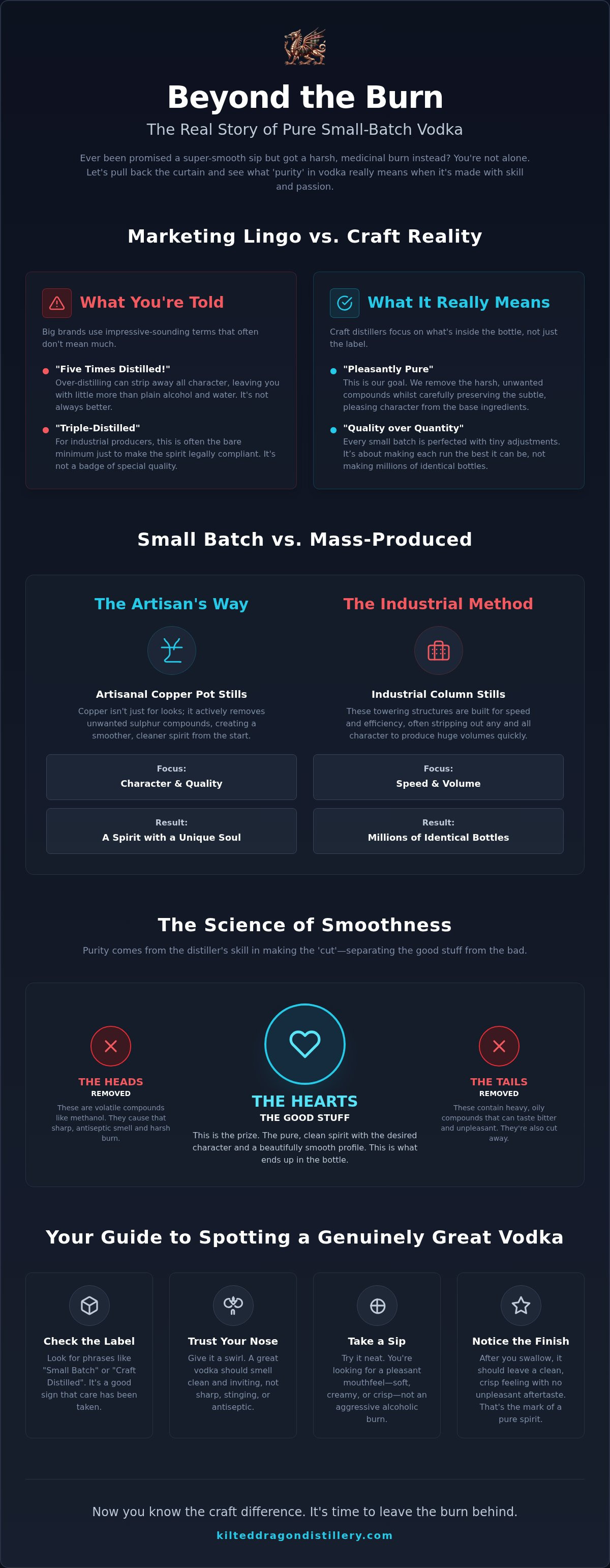
If there’s one skill that separates a master distiller from a machine, it’s the ability to make the perfect ‘cut’. Every distillation run produces three distinct parts: the heads, the hearts, and the tails. Only one of them is good enough for a premium bottle.
Heads, Hearts, and Tails: Think of a distillation run as a story with a beginning, a middle, and an end. The ‘heads’ are the first part of the run, the ‘hearts’ are the desirable middle, and the ‘tails’ are the final, fading part.
Why the "Heart" is the prize: The heart of the run is the purest part, rich in the smooth, clean ethanol that makes for a beautiful vodka. It's the distiller's job to collect this section and this section only.
The financial cost of purity: Making a very precise cut and collecting only a small ‘heart’ is expensive. It means discarding a significant portion of the alcohol from the run, which reduces the overall yield. This commitment to quality, not quantity, is a hallmark of true craft distilling.
The distiller's senses: An experienced distiller knows exactly when to make the cut not by looking at a gauge, but by using their nose and palate. They can identify the precise moment the spirit shifts from heads to hearts, and from hearts to tails, a skill that takes years to perfect.
The Heads: The harsh beginning
The first vapours to come off the still are packed with highly volatile compounds you definitely don’t want in your glass. This is the part that gives cheap spirits their nasty reputation.
The "nail polish remover" scent: The heads are full of compounds like acetone and methanol, giving them a sharp, chemical smell. It’s unmistakable and unpleasant.
Why mass-market brands include more heads: To maximise volume and profit, industrial producers often include a larger portion of the late heads in their final spirit. This is a primary cause of that aggressive "burn".
The impact on the burn: That stinging sensation at the back of your throat? That’s often the heads talking. A spirit made with a tiny, precise heart cut will have virtually none of this harshness.
The Tails: The oily end
As the distillation run nears its end, the character of the spirit changes again, becoming heavier and less pleasant.
The "funky" or heavy taste: The tails contain heavier, oilier compounds known as fusel oils. They can make a spirit taste dull, slightly greasy, or even have a strange, wet cardboard-like flavour.
Ensuring a crisp finish: A clean cut before the tails begin is essential for a vodka with a crisp, refreshing finish. By stopping the collection early, the distiller ensures none of that heavy, oily character clouds the final product.
This level of precision is the cornerstone of everything we do, ensuring that every spirit we craft, whether for our own brand or for our partners, meets the highest artisanal standards.
How to spot a truly pure vodka (and avoid the 'burn')
Now that you know what goes into making a superior vodka, it’s time to put your senses to the test. You don’t need to be a professional to identify quality. The best way to judge a vodka is to taste it at room temperature, without any ice or mixers to hide behind.
The "Nose" Test: Pour a small measure into a glass. Swirl it gently and take a sniff. A pure vodka shouldn’t smell of much at all, perhaps a faint sweetness or a hint of its base grain. What you shouldn’t smell is anything sharp, chemical, or like rubbing alcohol.
The "Sip" Test: Take a small sip and let it coat your tongue. Notice the texture—is it thin and watery, or does it have a pleasant weight and viscosity? The mid-palate should be clean, and the finish should be smooth and short, not lingering with a harsh burn.
The importance of "legs": Swirl the vodka around the glass and watch as it runs back down the sides. The streaks it leaves are called "legs" or "tears". Thicker, slower-moving legs can indicate a richer, more viscous mouthfeel, often a sign of a well-crafted spirit.
Why room temperature is best: Chilling or freezing vodka numbs your taste buds and masks both flaws and subtle flavours. Tasting it at room temperature allows the spirit’s true character to shine through, for better or for worse.
The sensory checklist
When you're tasting, keep this simple checklist in mind. A high-quality, pure small batch vodka should tick all these boxes.
Appearance: It should be perfectly crystal-clear, with no hint of cloudiness or sediment.
Aroma: The nose should be clean and neutral, with a possible underlying sweetness, not a chemical sting.
Palate & Finish: The spirit should feel smooth and slightly viscous in your mouth, and the finish should be quick, clean, and refreshing, leaving you ready for another sip.
Common myths about vodka quality
The spirits world is full of myths. Let’s debunk a few common ones to help you make smarter choices.
Does price always equal quality? Not necessarily. Whilst a ridiculously cheap vodka is unlikely to be good, a high price tag can sometimes be more about a fancy bottle and a huge marketing budget. Look past the packaging and focus on the story of how and where it's made.
Why you shouldn’t always hide vodka in a mixer: A great vodka is crafted to be enjoyed on its own or in a simple, spirit-forward cocktail like a Martini. If you only ever drink vodka with sugary mixers, you’re missing out on the subtle character that distillers work so hard to create.
The principles of spotting quality apply across all artisanal spirits. To learn more about how craft production is transforming other categories, check out our guide to UK agave spirit brands.
Meet The Purest Dragon: Our take on the perfect spirit
After exploring the art and science of purity, we want to introduce you to our expression of it: The Purest Dragon Vodka. It’s the culmination of our passion for distilling, a spirit born from a refusal to compromise and a dedication to the craft.
Introducing The Purest Dragon Vodka: This is our flagship vodka, a testament to what a pure small batch vodka can be. It's designed from the ground up to be exceptionally smooth, with a clean profile and a subtly creamy texture that makes it perfect for sipping.
A blend of Welsh and Scottish heritage: At Kilted Dragon, our identity is a fusion of two proud heritages. We bring the passion and creativity of Wales together with the time-honoured distilling traditions of Scotland to create something truly unique.
Our signature filtration process: To achieve its signature smoothness, every drop of The Purest Dragon undergoes a meticulous, multi-stage filtration process. This final polish ensures a crystal-clear spirit without stripping away the delicate mouthfeel we worked so hard to create in the still.
Perfect serves: Its clean character makes it the ideal base for a classic, crisp Martini. But we encourage you to try it neat, perhaps with a single large ice cube, to fully appreciate its refined simplicity.
Crafted with passion
The Purest Dragon isn’t just a product for us; it’s a statement of our values as distillers. It represents our unwavering commitment to the methods that define artisanal spirits.
Refusing to compromise on the "heart" cut: We make an exceptionally narrow heart cut for this vodka. It drastically reduces our yield, but it’s a sacrifice we are happy to make. It is the only way to guarantee the supreme smoothness and purity our name promises.
The story behind the name: The name reflects our mission: to create the purest possible expression of a small-batch spirit, embodying the strength and spirit of the Welsh dragon.
We invite you to discover the results of this passion. Explore our full range of spirits and taste the difference that craft makes.
The perfect gift for spirit lovers
In a world of mass-produced everything, a bottle of truly artisanal vodka stands out. It’s a sophisticated choice for a home bar and a thoughtful gift for anyone who appreciates quality.
The sophisticated choice: Gifting a bottle of small-batch vodka shows a discerning taste and an appreciation for craftsmanship. It’s a step beyond the usual big-name brands.
Pairing suggestions: For an exceptional gift set, consider pairing The Purest Dragon with one of our luxury liqueurs, offering a complete cocktail experience for the discerning drinker.
Ready to experience the pinnacle of purity? Order your bottle of The Purest Dragon today and discover how smooth a vodka can truly be.



Comments